


Payroll software helps small businesses automate recurring salary calculations, reduce repetitive data entry, maintain structured payroll records, and give employees easier access to payroll information. For SMEs with lean HR teams, the main advantage is reducing administrative effort while keeping payroll calculations, approvals, employee data, and statutory workflows in a more consistent process.
Quick Summary
- Reduce manual errors: Automate recurring calculations while retaining appropriate checks and approvals.
- Save HR time: Reduce repetitive spreadsheet work and routine payroll administration.
- Improve access: Let authorised users reach payroll information through supported devices and locations.
- Support self-service: Give employees direct access to payslips and permitted HR information.
- Scale with growth: Support changing employee volumes, salary structures, and payroll requirements.
- Support compliance: Help HR apply configured statutory payroll rules and maintain required records.
- Improve visibility: Use reports to review payroll costs, trends, deductions, and exceptions.
What Are the Benefits of Payroll Software for Small Businesses?
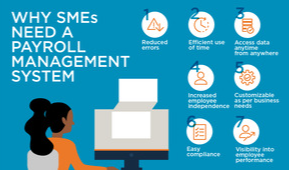
Investing in the right [https://www.greythr.com/payroll-software/]https://www.greythr.com/payroll-software/) can reduce repetitive payroll administration and give employees greater access to day-to-day payroll information. Cloud-based options can also reduce dependence on locally maintained spreadsheets and systems. Here are seven ways payroll automation can benefit SMEs.
.png "Payroll Management System")
1. How Can Payroll Software Reduce Manual Errors?
Payroll automation can reduce repetitive calculations and manual data entry, lowering the risk of errors introduced during those activities. HR teams should still validate employee data, payroll inputs, system configurations, exceptions, and final outputs before processing. Transaction and audit records can also support review and stronger checks and balances.
2. How Does Payroll Automation Save HR Time?
Manual payroll can require substantial effort from HR teams, especially when data is maintained in spreadsheets and calculations are repeated each pay cycle. Payroll automation can reduce time spent on recurring calculations and administrative processing, giving HR more capacity for activities such as onboarding, training, and learning and development.
3. How Does Cloud Payroll Software Improve Access?
Cloud payroll software can give authorised users access to payroll information from supported devices and locations, subject to the organisation's permissions and security controls. This can reduce dependence on office-based systems and make routine payroll work easier to complete across locations.
4. How Does Employee Self-Service Reduce Payroll Queries?
Payroll software with an employee self-service portal can give employees direct access to payslips, salary information, attendance records, leave balances, and other permitted HR information. Employees can also submit relevant requests through configured workflows instead of relying on HR for every routine transaction, which can reduce repetitive payroll and HR queries.
5. Can Payroll Software Scale as a Small Business Grows?
As small businesses add employees, salary structures, locations, or payroll rules, payroll requirements can become more complex. A suitable payroll system should support the company's current needs and allow it to handle higher payroll volumes or additional configurations as requirements change. Buyers should confirm scalability, storage, and plan limits with the vendor.
6. How Can Payroll Software Support Compliance?
Payroll software can help HR teams apply configured statutory deductions, calculations, records, and reporting requirements. Some products also maintain statutory payroll updates for supported jurisdictions, reducing manual rule maintenance. Businesses should still verify that employee data, payroll settings, policies, and processes align with the requirements that apply to them.
7. How Does Payroll Software Improve Payroll Cost Visibility?
Payroll reports can help HR and finance teams review salary costs, payroll trends, deductions, exceptions, and other workforce cost data captured by the system. Where the software supports relevant breakdowns, teams can analyze payroll information by employee group, department, or other business dimensions without treating payroll data as a substitute for performance-management data.
Payroll can become time-consuming as employee numbers, salary structures, deductions, and reporting requirements grow. The right payroll software can reduce repetitive administration, make payroll information easier to access, and support more consistent processing. Small businesses should evaluate software based on payroll complexity, compliance needs, integrations, employee self-service requirements, reporting, and budget. For a product comparison, see payroll software for small businesses.
About greytHR
greytHR is a full-suite HRMS trusted by 34,000+ organisations and 3.5 million+ employees across 30+ countries. This cloud-based platform helps businesses manage the complete employee lifecycle, including manpower planning, recruitment and onboarding, core HR, leave and attendance, timesheets, payroll and statutory compliance, performance and expense management, and exit. With built-in Agentic AI working across every module, HR teams can surface insights instantly and make data-driven decisions. greytHR is widely recognised for its dedicated in-house support team and strong Indian and GCC statutory payroll compliance.
Frequently Asked Questions
What is payroll software for small businesses?
Payroll software for small businesses is a system that helps calculate salaries, deductions, reimbursements, and other payroll inputs while maintaining payroll records and outputs. Depending on the product, it may also connect with attendance, leave, employee self-service, accounting, or statutory workflows so HR teams do not have to manage the same information manually across multiple tools.
Why do small businesses need payroll software?
Small businesses often operate with lean HR or finance teams, so repetitive payroll calculations and manual data entry can consume significant administrative time. Payroll software can automate recurring processing, organise payroll records, support employee access to payroll information, and provide structured workflows as employee numbers and payroll requirements become more complex.
What are the main benefits of payroll automation?
Payroll automation can reduce repetitive calculations and data entry, save administrative time, improve access to payroll records, support employee self-service, and provide more consistent reports. It can also support statutory payroll workflows when the software is configured for the relevant jurisdiction and kept aligned with current business requirements.
How does payroll software help with compliance?
Payroll software can help apply configured statutory deductions, calculations, records, and reporting requirements. Some products also update supported statutory rules when requirements change. However, software does not guarantee compliance: businesses still need accurate employee data, correct system configurations, current policies, and appropriate review of the requirements that apply to them.
What should a small business look for in payroll software?
A small business should evaluate payroll software based on payroll complexity, employee count, statutory coverage, ease of use, integrations, employee self-service, reporting, security controls, support, pricing, and scalability. The best fit is a system that handles the workflows the business actually needs without creating unnecessary administration.
Author(s)
Vijay Balakrishnan
Vijay Balakrishnan is the Chief Marketing Officer at Greytip, leading the Marketing function. As a results-driven marketer, he has held Marketing Leadership & CXO positions at some of India’s largest and finest corporations.Share this


