


Quick Answer
- A sick leave application is a short written request submitted by email, HRMS, or letter to inform your employer that you are unwell and need paid time off.
- 1 to 2 days: Inform your manager first by call or WhatsApp, then send a quick email. Most companies do not ask for a medical certificate for short absences.
- 3 or more days: You need an email application plus a medical certificate from a registered doctor.
- What to include: Your name, Employee ID, leave dates, a one-line reason, and whether a certificate will follow.
- Key rule: Always apply in writing even for a single day. It protects your leave balance and keeps your attendance record clean.
- Quickest route: Apply through your company's HRMS portal. Approval and payroll update happen automatically.
You are already feeling unwell. The last thing you need is to spend 20 minutes figuring out what to write to your manager. So here it is.
This page has every sick leave format you will need, whether it is a one-liner for a single day, something more formal for three or four days, or a physical letter for a traditional workplace. Find what fits your situation, fill in the blanks, and get some rest.
Sick Leave Application Samples: Ready to Copy
All samples are for office and professional use in India. Pick your scenario.
1. One Day Sick Leave Application for Office
Use this when you are not well enough to come in. Works for fever, headache, body ache, or anything that needs a day of rest.
Subject: Sick Leave – [Your Name] – [Date]
Dear [Manager's Name],
I am unwell today and will not be able to come in. Requesting one day of sick leave for [Date].
I will be reachable on phone if anything urgent comes up.
Regards, [Full Name][Employee ID] | [Department] | [Contact Number]
For a single-day leave, three or four lines is genuinely all you need. Managers appreciate not having to read a paragraph when the request is straightforward.
2. Two Days Sick Leave Application for Office
A viral infection, bad cold, or anything that needs a couple of days to clear up.
Subject: Sick Leave Application – [Your Name] – [Date] to [Date]
Dear [Manager's Name],
I am not well and need two days of sick leave: [Date] to [Date].
[Colleague Name] is aware of any urgent tasks. I will be reachable on [Phone Number] if something comes up.
Regards, [Full Name][Employee ID] | [Department]
3. Sick Leave Application for Fever
This one is for when you are running a temperature, have been to the doctor, and need a couple of days to recover properly.
Subject: Sick Leave – Fever – [Your Name] – [Start Date] to [End Date]
Dear [Manager's Name],
I have had a high fever since [yesterday / today]. My doctor has asked me to rest for [X] days, so I am applying for sick leave from [Start Date] to [End Date].
I will bring a medical certificate when I return if needed. [Colleague Name] has been briefed on anything pending.
Regards, [Full Name][Employee ID] | [Department] | [Contact Number]
4. Half Day Sick Leave Application for Office
Useful when you feel okay enough to work part of the day, or when you have a morning appointment but can come in later.
Subject: Half Day Sick Leave – [Your Name] – [Date]
Dear [Manager's Name],
Not feeling great this morning. Requesting a half day today ([Date]) for the [morning / afternoon] session.
I will be in by [Time] / logging off after [Time].
Regards, [Full Name][Employee ID] | [Department]
5. Formal Sick Leave Application to Manager (3 or More Days)
For extended illness where your manager and HR both need to be informed. This is the format to use for formal workplaces and when writing an application for sick leave in English.
Subject: Sick Leave Application – [Your Name] – [Date Range]
Dear [Manager's Name],
I am writing to apply for sick leave from [Start Date] to [End Date], which is [X] working days.
I have been suffering from [fever / viral infection / medical condition] and Dr. [Name] at [Hospital / Clinic] has recommended rest. I saw the doctor on [Date] and will submit the medical certificate when I return.
I have handed everything over to [Colleague Name] and briefed them on what is ongoing. You can reach me on [Phone Number] for anything that genuinely cannot wait.
Kindly approve my leave.
Thank you.
[Full Name][Employee ID] | [Department] | [Contact Number]
6. Short Sick Leave Message (WhatsApp or Informal)
When your team runs on WhatsApp or you need to send something fast before following up formally.
Hi [Manager's Name],
Not well today. Running a fever. Taking sick leave for [today / today and tomorrow]. Will apply on HRMS / send a formal email too.
On WhatsApp if anything urgent comes up. [Colleague Name] knows.
– [Your Name]
Always follow up with a formal application even after a WhatsApp message. The message informs. The written record protects your leave balance.
7. Sick Leave Application Letter Format (Physical Letter)
For companies that still require printed applications. Common in manufacturing, government-adjacent workplaces, and traditional setups.
Date: [Date]
To, [Manager's Name][Designation] [Company Name][Address]
Subject: Application for Sick Leave
Dear Sir / Madam,
I, [Your Full Name], working as [Designation] in [Department], wish to apply for sick leave for [X] days from [Start Date] to [End Date].
I have been unwell since [Date] and consulted Dr. [Name] at [Hospital / Clinic], who has advised [X] days of rest. I will submit the medical certificate when I return to duty.
Kindly grant me sick leave for the above period.
Thanking you,
[Full Name][Employee ID] | [Department] | [Contact Number]
What Is a Sick Leave Application?
When you are unwell and cannot come to work, your employer needs to know two things: that you will not be in, and for how long. A sick leave application does exactly that, whether it is a two-line email, an HRMS submission, or a formal letter.
There is a practical reason to always write it down even for a single day. Without a written record, your absence can get marked as unpaid leave even if you have sick leave balance sitting there. A two-minute email prevents that.
Is Sick Leave Mandatory in India?
No single central law covers sick leave for all private sector employees. Several state Shops and Establishments Acts do mandate it though, and most companies offer it regardless.
| Law | Applies To | Sick Leave Provision |
|---|---|---|
| Maharashtra Shops & Establishments Act | Maharashtra private sector | 7 days per year |
| Karnataka Shops & Establishments Act | Karnataka private sector | 12 days per year |
| Delhi Shops & Establishments Act | Delhi private sector | 10 days per year |
| Factories Act, 1948 (Section 79) | Factory workers | Earned leave, used as sick leave in practice |
| CCS (Leave) Rules, 1972 | Central government employees | 20 days half-pay leave per year |
If you work in a state-covered establishment and your employer is not giving you the minimum sick leave the law requires, you can raise it with the Labour Commissioner.
Who Can Take Sick Leave?
Permanent employees are fully eligible, with leave credited at the start of each year.
Probationary employees can usually take it too, sometimes at a smaller quota. Your appointment letter will have the specific terms.
Contract workers generally fall outside company sick leave policy, though state law may apply depending on the nature of the engagement.
Factory workers are covered under the Factories Act, 1948.
Central government employees get 20 days of half-pay leave per year under CCS (Leave) Rules, 1972.
How Many Sick Leave Days Do You Get?
Most Indian private sector companies provide somewhere between 6 and 12 sick leave days per year.
| Sector or State | Days Per Year | Basis |
|---|---|---|
| IT and Technology | 6 to 12 days | Company policy |
| BFSI | 7 to 10 days | Company policy |
| Maharashtra | Minimum 7 days | Maharashtra S&E Act |
| Karnataka | Minimum 12 days | Karnataka S&E Act |
| Delhi | Minimum 10 days | Delhi S&E Act |
| Central government | Around 10 full-pay equivalent days | CCS Leave Rules, 1972 |
| Factory workers | 12 to 15 days typically | Factories Act and state rules |
Your actual quota depends on your company's policy and your state. When in doubt, check your employee handbook or ask HR directly.
Is Sick Leave Paid?
Yes. Sick leave taken within your annual quota is fully paid. Your salary for those days is not touched.
| Scenario | What Happens |
|---|---|
| Within your annual quota | Fully paid, no deduction |
| Quota used up, adjusted against casual leave | Paid from your CL balance |
| Quota used up, adjusted against earned leave | Paid from your EL balance |
| All leave balances exhausted | Salary deduction: monthly salary divided by working days, multiplied by days absent |
| No application submitted at all | Marked as unpaid leave regardless of reason |
Five Things About Sick Leave That Catch People Off Guard
- Tell your manager before you apply, not after. A WhatsApp or call in the morning comes first. Applications submitted without any prior notice on the day sometimes get questioned, even when the leave is genuine.
- Three consecutive sick days usually need a medical certificate. Some companies ask for one even for a single day. Check your policy once so you know before you need it.
- Always apply in writing even for a single day. A verbal mention to your manager does not protect your leave balance. An email or HRMS entry does.
- Unused sick leave does not roll over. In most private companies, whatever you have not used by year end is gone. It cannot be carried forward and cannot be encashed.
- Patterns get noticed over time. Repeatedly taking sick leave on Mondays, Fridays, or the day after a public holiday tends to come up in performance conversations. Not as a disciplinary matter necessarily, but it does get noticed.
Common Mistakes That Slow Down Approval
Writing vague dates is the most frequent one. "I will be out for a few days" forces a follow-up from your manager. Write the exact start and end date.
Not mentioning your work handover is the second. Even a single line, something like "nothing critical today" or "[Name] knows about the pending report," makes the approval faster.
Oversharing your medical situation is worth avoiding. Fever and body ache is enough. Your manager does not need a clinical description.
Not following up when there is no response is a mistake many people make. If you have not heard back in a few hours, a short message is perfectly reasonable.
Sending only to HR and forgetting your manager, or the other way around, causes confusion. Your direct manager gets the first email. HR gets CC'd for anything beyond a couple of days.
How to Apply for Sick Leave: Step by Step
Option A: By Email
Riya wakes up with a fever at 7 AM. Her office starts at 9:30.
She sends her manager a WhatsApp first: "Not well today, taking sick leave. Sending you an email."
Then she picks the right format from the templates above, fills in her name, dates, and doctor's name, and sends the email before work starts. HR is copied because her company requires it for sick leave.
Her manager replies with approval. That is the official record. When Riya comes back on Thursday, she attaches the doctor's certificate to a follow-up email and uploads it to the HRMS.
Option B: Through the HRMS Portal
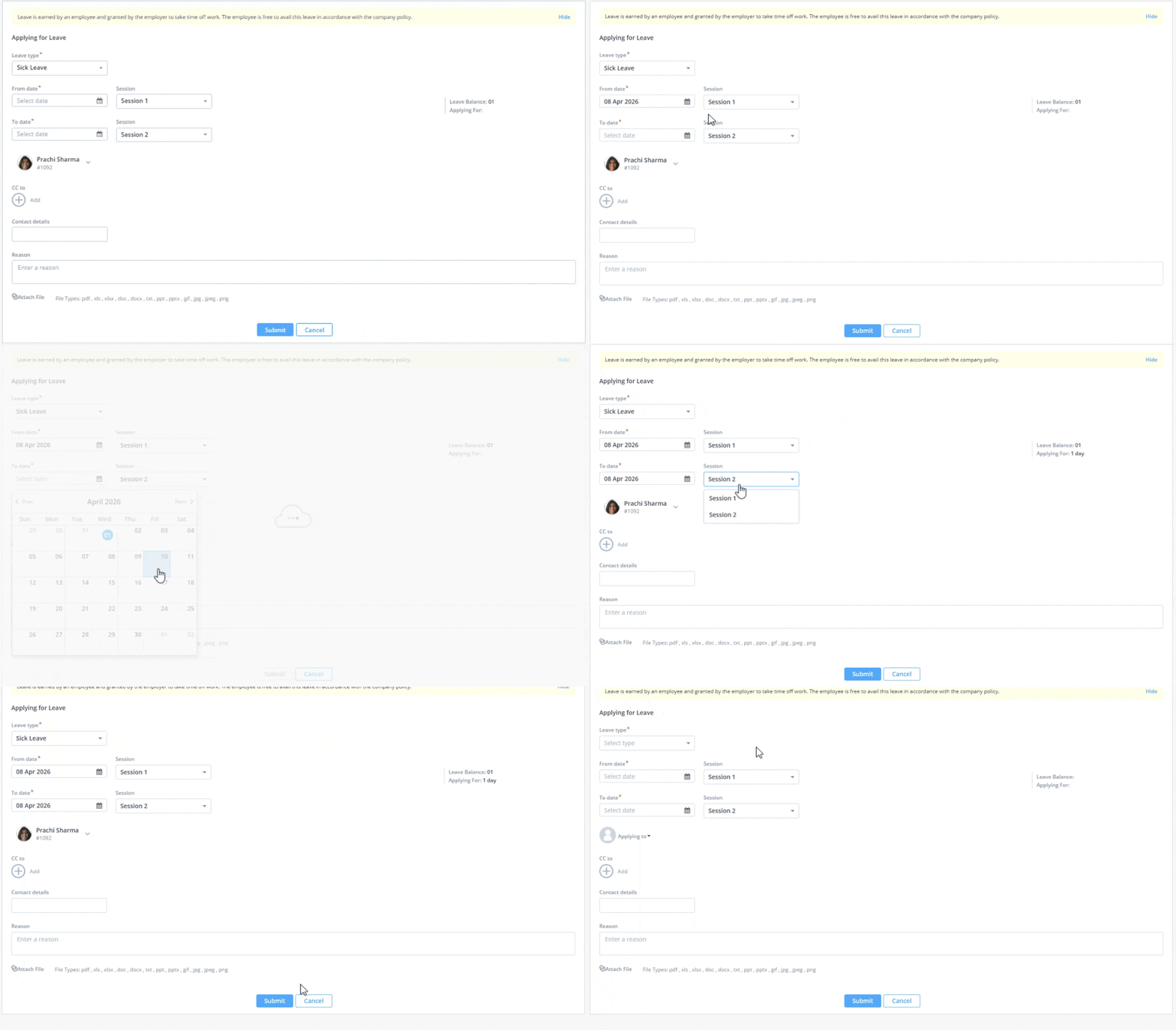
Karan uses his company's ESS portal. He wakes up sick on a Monday morning.
He opens the portal on his phone and logs in. From the main dashboard, he taps Leave Management, then Apply Leave.
He selects Sick Leave from the leave type dropdown. His remaining balance shows immediately. He picks today's date, types "fever, on doctor's rest" in the reason field, and attaches a photo of his prescription.
He taps Submit. His manager gets a notification. The status shows as Pending Approval.
Once the manager approves, Karan gets a notification. His sick leave balance drops by one day and payroll updates automatically. No email thread, no manual HR entry.
greytHR ESS Portal leave application flow showing leave type selection and submission
How HR Handles Sick Leave
For single-day requests, the manager approves and HR gets an automatic HRMS notification. Nothing more is needed unless the employee is on an attendance watch.
For three or more consecutive days, HR checks the available balance, asks for a medical certificate, and confirms the approval in writing.
When the quota is exhausted, HR tells the employee clearly what the LOP implications are and offers adjustment against casual or earned leave first.
For repeated patterns of sick leave near weekends or holidays, the standard approach is a one-on-one conversation, not an automatic rejection. It is a wellbeing check.
Every HR response should go out in writing, with the status, dates, and any salary implications stated clearly.
Can a Sick Leave Application Be Rejected?
Yes, but only for valid reasons.
Rejection is fair when the annual quota is already used up, when no medical certificate was submitted for a long absence despite the policy requiring one, or when the application does not match the stated reason.
Rejection is not fair when it is driven by operational inconvenience, or when an employee is penalised for using leave they are legitimately entitled to.
In states where sick leave is a statutory right, a wrongful rejection can be taken to the Labour Commissioner.
Sick Leave vs Casual Leave vs Earned Leave
| Sick Leave | Casual Leave | Earned Leave | |
|---|---|---|---|
| Purpose | Illness or medical | Personal, short notice | Planned vacation |
| Prior notice | Not needed, same day | One day preferred | 7 to 15 days |
| Medical certificate | Usually needed for 3 or more days | No | No |
| Carry forward | Usually no | No | Yes with cap |
| Encashment | No | No | Yes on exit |
Frequently Asked Questions
What should I write in a sick leave application?
Your name, Employee ID, the dates you need off, and a brief one-liner explaining you are unwell. For three or more days, mention that a medical certificate will follow. You are not obligated to share detailed health information. "Not feeling well" or "medical reasons" is enough for short absences.
Can I apply for one day sick leave without a medical certificate?
For one or two days, most companies accept a brief reason without any certificate. For three or more consecutive days, a registered doctor's certificate is typically required. Some companies want one even for a single day, so it is worth checking your policy before you actually need it.
How do I write a sick leave application for fever?
Use Template 3 above. Mention that you have had a fever since a specific date, that your doctor has advised rest, state the dates you need, and note that a certificate will follow if needed. One short paragraph is more than enough.
What happens if I do not apply formally?
Your absence can be marked as Loss of Pay even if you have sick leave available. Always apply in writing, even for a single day, through email or your company's HRMS.
Can I take sick leave during probation?
Most companies allow it, sometimes at a smaller quota. Genuine medical situations are usually accommodated even in restrictive policies, though extra days beyond what the policy allows may be treated as LOP. Your appointment letter will have the specific terms.
What is the difference between a sick leave email and a formal letter?
The content is the same: your name, dates, reason, and certificate note. What changes is the format. An email has a subject line and a slightly more conversational tone. A physical letter includes the date, the recipient's address, and a more formal salutation. For most Indian offices today, email or HRMS is the standard channel.
A Quicker Way to Manage Sick Leave
If your team still runs leave requests through email chains and spreadsheets, here is what that actually costs in practice:
| Feature | Manual Process | HRMS Portal |
|---|---|---|
| Time to apply | 10 to 20 minutes | 30 seconds |
| Manager notification | Email, can be missed | Instant mobile and web notifications |
| Leave balance update | HR updates manually | Updates automatically |
| Certificate tracking | Email attachments, scattered | Uploaded and tracked in portal |
| HR reporting | Compiled manually | Auto-generated reports |
Modern HR software turns what used to be a 15-minute exercise into a 30-second portal entry. The employee goes back to resting. The manager approves from their phone. HR sees everything without chasing anyone.
Author(s)
greytHR
greytHR is a full-suite HRMS platform that automates HR processes and empowers employee self-service. It ensures all-around productivity and engaged employees — the crucial ingredients for growth.Share this


