


Startup owners are laser-focused on growing their businesses faster. Productivity and profitability are their primary challenges. Therefore, many promoters go the whole hog at work and also urge their people to follow suit. Startup owners know the importance of addressing their employees’ wants and needs. Therefore, they work closely with the team members and even handhold them whenever they face challenges. In reality, these business owners may not always have the resources to meet all their employees’ expectations.
Payroll software for startups automates the complex, time-consuming work of calculating exemptions, deductions, and payouts. The best option for a fast-emerging startup is a cloud-based HRMS with an advanced payroll module that controls the entire payroll cycle: gathering inputs, calculating salaries, making payouts, and completing compliance formalities.
Quick Summary
- Payroll sounds simple, paying employees for a period, but exemptions, deductions, and payouts make it complex and time-consuming.
- Manual and spreadsheet processes cause payment delays, computation discrepancies, demotivation, and compliance penalties.
- The four common options (spreadsheets, standalone payroll tools, basic HR software, outsourcing) all have limits in cost-efficiency, security, and scalability.
- The best option: a cloud-based HRMS with advanced payroll, easier to maintain, manage, and scale, and more affordable than on-premise.
- 16 core features to expect, from customizable salary structures and IT declaration to accounts JV and payslip distribution.
- Choose on six criteria: scalability, ease of operation, self-service portal, integration, security, and support.
Startup owners are laser-focused on growing their businesses faster. Productivity and profitability are their primary challenges. Therefore, many promoters go the whole hog at work and also urge their people to follow suit. Startup owners know the importance of addressing their employees' wants and needs. Therefore, they work closely with the team members and even handhold them whenever they face challenges. In reality, these business owners may not always have the resources to meet all their employees' expectations.
Why Is Payroll Management a Challenge for Startup Managers?
Payroll challenges startups because calculating exemptions, deductions, and payouts is complex and time-consuming, and manual, spreadsheet-based processes produce payment delays, computation discrepancies, and compliance penalties that young businesses can least afford.
Payroll management is about paying a certain number of employees for their work during a specified period. Though it sounds simple, the calculation of exemptions, deductions, and payouts makes the process complex and time-consuming.
Many startups follow manual and spreadsheet-based processes, resulting in payment delays and computation discrepancies. This can snowball into a bigger problem, resulting in employee demotivation and high turnover rates.
Also, legacy payroll processes and the lack of payroll processing skills could lead to compliance issues and hefty penalties for the business.
Why Is Payroll Management a Challenge for Startup Managers?
Payroll challenges startups because calculating exemptions, deductions, and payouts is complex and time-consuming, and manual, spreadsheet-based processes produce payment delays, computation discrepancies, and compliance penalties that young businesses can least afford.
Payroll management is about paying a certain number of employees for their work during a specified period. Though it sounds simple, the calculation of exemptions, deductions, and payouts makes the process complex and time-consuming.
Many startups follow manual and spreadsheet-based processes, resulting in payment delays and computation discrepancies. This can snowball into a bigger problem, resulting in employee demotivation and high turnover rates.
Also, legacy payroll processes and the lack of payroll processing skills could lead to compliance issues and hefty penalties for the business.
Why Can Startups Count on an Advanced Payroll Software?
Because every other route, spreadsheets, standalone payroll tools, basic HR software, or outsourcing, has limitations in cost-efficiency, security, and scalability. A cloud-based HRMS with advanced payroll is easier to maintain, manage, and scale, and more affordable than on-premise solutions.
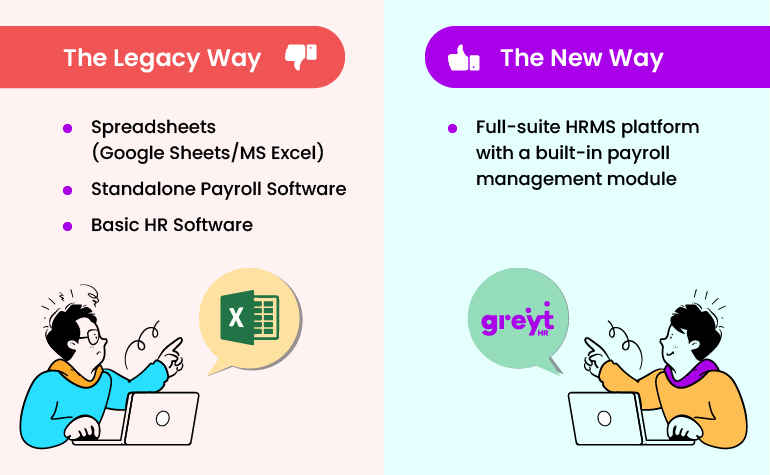
There are multiple ways to handle the payroll function in a startup: with spreadsheets, standalone payroll software, or a basic HR software. Alternatively, they can outsource the work to an external agency offering payroll services. All of these options could have their limitations in terms of cost-efficiency, security, and scalability.
The best option for a fast-emerging startup is a cloud-based, full-suite HRMS with an advanced payroll software. These solutions offer the much-needed flexibility to startups. Unlike the clunky on-premise software solutions, they are easier to maintain, manage, and scale. Moreover, they are more affordable.
What Makes an Advanced Payroll Software Feature-Rich & Future-Ready?
An advanced payroll software puts the HR team in control of the entire payroll cycle, from gathering inputs and calculating salaries to making payouts and completing compliance formalities, with employees handling several tasks themselves via the self-service portal.
An advanced payroll software puts the HR team in control of the entire payroll cycle, not just a couple of stages. There are multiple tasks to be performed by both employers and employees on a monthly and yearly basis. Some of these tasks can be carried out by employees via the self-service portal.
The payroll cycle includes numerous activities, from gathering payroll inputs and calculating salaries to making payouts and completing compliance formalities. Let's look at the core features of a good payroll software for startups.
- Customizable salary structures
- Unlimited salary components
- IT declaration
- Payroll inputs
- Flexible benefit plan (FBP)
- Reimbursements & expenses
- Payroll processing
- Statutory compliance
- Accounts JV
- Verification & reconciliations
- Loans & salary advances
- Proof of investments
- Salary transfer to bank account
- Payslip generation & distribution
- Reports and statements
Treat this list as your demo scorecard: ask each vendor to show these features live with a sample employee, and the differences between products become visible in an hour.
How Do You Zero In on an Advanced Payroll Software?
Evaluate six criteria before selecting or upgrading: scalability for fast headcount growth, ease of operation, an employee self-service portal, integration with attendance and accounting systems, data security, and timely vendor support.
The decision to select or upgrade a payroll software calls for the evaluation of multiple parameters. Businesses in their initial stages may not have the bandwidth to make heavy investments in technology. However, prudent use of technology can help these businesses, particularly startups, control costs and boost operational efficiency. Let's look at a few criteria for selecting payroll software for startups, and see how these stack up across our top 10 payroll software in India guide
Scalability
Startups are likely to increase their headcount faster than their larger counterparts. When this happens, they must also wield the know-how and tools to manage their payroll effectively. At this juncture of their business journey, they must deploy a payroll software that provides easy access to more helpful features. When the payroll software functions without glitches, their employees get paid accurately and on time. This results in better employee motivation and higher productivity.
Ease of operation
The deployment of a payroll software is a good milestone in the journey of a startup. But it shouldn't end there. The HR/payroll team has to use it optimally to realize the full range of benefits. A complex solution defeats the purpose for which it has been deployed. The chosen software must be easy to learn and use. The technology provider must also provide the necessary training and documents after the payroll software is implemented.
Employee self-service portal
Only a sophisticated and financially sound startup will be able to employ a full-fledged payroll/HR team from the get-go. Hence, it makes more sense for these businesses to have a full-suite HRMS platform with a self-service portal and mobile app. Employees can use the same to mark attendance, apply for leave, download payslips, declare investments, and do much more without reaching out to HR. The payroll module will automate payroll-related tasks seamlessly. This helps HR focus on more business growth-oriented tasks instead of handling repetitive employee queries related to payroll.
Integration with other systems
There are many methods and tools to process payroll. However, an advanced payroll software will have the provision for seamless integration with time, leave, and attendance management systems and accounting software. Modern payroll automation tools use AI/ML to extract information from multiple sources and process payroll quickly and accurately. Since all the activities are performed on one platform, the payroll team can experience stress-free month ends, month after month!
Security
A professional business has to collect the employees' personal information for compliance purposes. It also manages a lot of other sensitive information, including the employees' bank details, UAN, and investment proofs. Therefore, the payroll software must ensure data security through data encryption, 2-factor authentication, restricted access, and password protection, among other measures.
Support
Not all startups would have the resources to handle payroll or payroll software-related complexities. Therefore, they must identify a vendor who offers timely and personalized technical support from the outset. Their plans must be flexible and affordable enough to allow this provision. The providers of advanced payroll software solutions usually offer a comprehensive suite of support resources for both employers and employees. The concerned team can access this support through multiple channels like phone, email, chat, and in person.
Summing Up
Productivity and profitability are usually the top priorities of startup companies. But they can't afford to give the other functions a stepmotherly treatment. Payroll, for instance, is a crucial function responsible for accurate and prompt salary payouts. The payroll team must also address employee benefit-related queries thoughtfully and professionally. Not every emerging business would have comprehensive policies for everything related to HR and payroll.
An advanced payroll software can address the challenges of payroll processing. It automates many of the tasks and creates more bandwidth for payroll managers. Even the employees can perform basic payroll-related tasks on their own. This results in higher employee satisfaction. For this to happen, the business has to choose the right payroll software that is scalable and easy to operate. It must also be secure and interoperable. Most importantly, the level of support and the vendor's credibility matter a lot. All said and done, it pays to deploy an advanced payroll software in any business, whether a startup or a large enterprise.
About greytHR
greytHR is a full-suite HRMS trusted by 34,000+ organisations and 3.5 million+ employees across 30+ countries. This cloud-based platform helps businesses manage the complete employee lifecycle, including manpower planning, recruitment and onboarding, core HR, leave and attendance, timesheets, payroll and statutory compliance, performance and expense management, and exit. With built-in Agentic AI working across every module, HR teams can surface insights instantly and make data-driven decisions. greytHR is widely recognised for its dedicated in-house support team and strong Indian and GCC statutory payroll compliance.
Frequently Asked Questions
Do startups really need payroll software?
Yes. Exemptions, deductions, and payouts make payroll complex from the first hires, and manual processes cause delays, discrepancies, and compliance penalties.
What is the best payroll option for a startup?
A cloud-based HRMS with advanced payroll: more flexible, affordable, and scalable than spreadsheets, standalone tools, basic HR software, or outsourcing.
What features should startup payroll software include?
Customizable salary structures, IT declaration, FBP, reimbursements, statutory compliance, accounts JV, reconciliations, bank transfers, and payslip distribution.
What criteria matter most when choosing?
Scalability, ease of operation, an employee self-service portal, integrations, data security, and timely vendor support.
How does self-service help a startup?
Employees mark attendance, apply for leave, download payslips, and declare investments themselves, freeing HR for growth-oriented work.
Author(s)
greytHR
greytHR is a full-suite HRMS platform that automates HR processes and empowers employee self-service. It ensures all-around productivity and engaged employees — the crucial ingredients for growth.Share this


