


The key differentiators between HRMS, HRIS, and HCM come down to scope: HRIS is the narrowest, managing employee and HR policy data; HCM manages employees as human capital for strategic functions; and HRMS is the broadest, adding time & labour management (TLM) and payroll processing on top of everything in HRIS and HCM.
Quick Summary
- The terms HRMS, HRIS, and HCM are loosely used with no carved-in-stone definitions, so configurations vary vendor to vendor.
- HRIS: the narrowest, collates employee and policy data in one place for analysis and reports; ideal standalone for smaller businesses.
- HCM: manages employees as human capital, optimizing experience and potential for strategic rather than administrative functions.
- HRMS: the broadest, everything in HRIS and HCM plus TLM and payroll processing; suits companies of every size.
- 16 key modules explained, from TLM, payroll, and recruitment to analytics, position control, and global support.
- Choose by mapping what your company actually needs against the modules, not the label on the software.
A vast array of HR management software is available in the market today. Hence, it has become extremely confusing for businesses to identify the right HR software solutions. Understanding what these technologies are and how they can help is the most crucial step toward finding the best fit.
One significant factor that results in the above-mentioned dilemma could be the lack of standard or defined rules for configuring an HR system. The configuration largely depends on what a company needs. For example, some companies would have outsourced their talent acquisition or payroll functions entirely but need others like data management, leave and attendance, record management, etc. They might choose to call this system an HRMS or an HRIS.
HRMS, HRIS & HCM: What Do they Mean?
HRMS (human resource management system), HRIS (human resources information system), and HCM (human capital management) are loosely used industry terms with no fixed definitions, so what each includes can vary from vendor to vendor.
The terms like HRMS (human resource management system), HRIS (human resources information management) and HCM (human capital management) are quite loosely used in the industry, and hence spell a lot of confusion. Since there is no carved-in-the-stone definition, the same can vary from vendor to vendor.
What is HRIS?
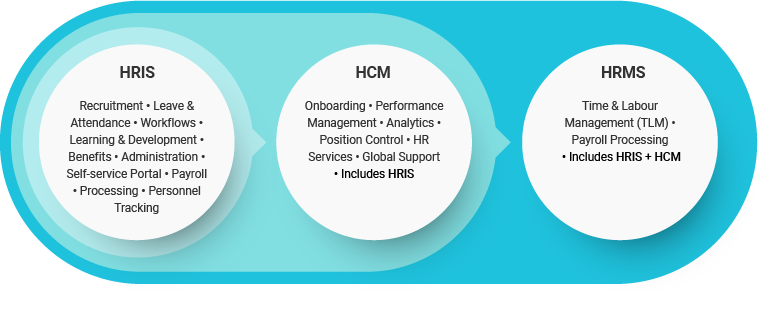
HRIS is the narrowest of the three: it manages and processes data related to employees and HR policies, collating everything in one place so HR can analyse and report easily. A standalone HRIS is ideal for smaller businesses.
The narrowest among the three, HRIS is about managing and processing data related to employees and HR policies. It collates all the data in one place, so it is easy for HR to do their analysis and generate relevant reports. A standalone HRIS is ideal for smaller businesses.
What is HCM?
HCM treats employees as the company's vital assets, its human capital. An HCM system manages employees and their experiences and optimizes their potential, handling strategic functions rather than regular administrative tasks.
Employees are a company's vital assets or human capital. Therefore, a system that manages employees/their experiences, and optimizes their potential, is usually called the Human Capital Management system. It's usually used for handling more strategic functions and not the regular administrative tasks.
What is HRMS?
An HRMS offers everything in HRIS and HCM plus time & labour management (TLM) and payroll processing, making it the broadest of the three and suitable for companies of every size.
In addition to everything in HRIS and HCM, an HRMS offers time & labour management (TLM) and payroll processing. In other words, an HRMS (HR management system) is the broadest among all the three. It's suitable for all types of companies, irrespective of their size. HR, as a function, has a series of tasks and procedures to be performed. Different HRMS software solutions modules handle these different tasks or sets of tasks. In this post, we have segregated the modules and also briefly explained all of them.
A quick memory aid: HRIS keeps the records, HCM grows the people, HRMS runs the whole operation including time and pay. If payroll and attendance must live in the same system as employee data, an HRMS is the category to shop in.
What are the Key Modules of an HRMS?
An HRMS is built from modules, sixteen of the most common being: TLM, payroll processing, recruitment, leave & attendance, workflows, L&D, benefits administration, employee self-service, personnel tracking, onboarding, performance management, analytics, position control, HR services, and global support.
Time & Labour Management (TLM)
Records the exact number of working hours with punch-in and punch-out timings, tracks task-related timelines and enables quick approvals for optimising employee productivity.
Payroll Processing
Gathers employee information, calculates deductions & payout, processes direct deposits to employee accounts and automatically updates payroll records.
Recruitment
Allows HR to post JDs and candidates to review and post their resumes. It also includes an interview scheduler up to the hiring stage.
Leave & Attendance
Performs regular tracking of attendance, data on LOP/reversal of LOP to payroll, workflow for leave application, approvals, updation of leave records, quota management, leave encashment and more.
Workflows
Configures action items for different stakeholders to review and approve/reject different types of applications submitted by employees.
Learning & Development
Captures specific L&D needs of employees for enhancing skill sets, and tracks mandatory training/counselling/emotional support programs.
Benefits Administration
Enables HR to define and manage benefits programs while employees can stay updated. The right benefits help attract and retain the right employees.
Employee Self-service
An ESS portal offers employees anywhere, anytime access to their official information. This ensures better transparency, engagement, and higher productivity.
Personnel Tracking
Also called employee tracking, personnel tracking helps HR keep track of an employee's work location, activities and performance. The system also has an updated record of the relevant personal details of all employees.
Onboarding
Expedites the employee onboarding process with digital data collection and verification while minimizing paperwork and errors.
Performance Management
Provides a system for setting up and tracking short-term/long-term employee goals, outstanding achievements, recognition, promotions, salary changes, feedback, surveys, opinions and more.
Analytics
Configures the database and IT infrastructure to collect, analyze and store disparate data. Also generates reports related to headcount, data validation, salary costs, audit schedules and reconciliation, among others.
Position Control
Tracks information and enables budgeting and planning based on positions rather than employees. The objective is to ensure that the right people are placed in the right positions.
HR Services
Speeds up HR tasks by providing easy access to policies, procedures, company/government rules, FAQs, employee queries, chats, tax support, employee letters, record management and reminders.
Global Support
Offers support in multiple languages for customers across locations. Also has a built-in feature to display monetary values and process transactions in the local currency.
Wrapping Up
We hope this article helps you get an understanding of HR software systems, HRMS, HRIS and HCM, and what to expect from the HRMS software company.
When you evaluate options, list the modules above and mark which ones your organisation needs today and in two years. If payroll, TLM, leave, and compliance all make the list, a full-suite HRMS covers them on one platform instead of stitching separate tools together.
See how greytHR brings payroll, leave, attendance, and compliance together in one place. Explore greytHR, the full-suite HRMS, or start a free trial to run your entire people operations on a single platform.
greytHR is India's leading HR and payroll platform, offering 50+ Hire-to-Retire tools that automate recruiting, onboarding, payroll, attendance, leave, and compliance. Trusted by 34,000+ businesses, it manages over 3.2 million employees across 25+ countries.
Frequently Asked Questions
What is the difference between HRMS, HRIS, and HCM?
HRIS is the narrowest (employee and policy data), HCM manages employees strategically as human capital, and HRMS is the broadest, adding TLM and payroll processing to everything the other two offer.
Which is best for a small business: HRIS, HRMS, or HCM?
A standalone HRIS suits smaller businesses needing data and reports; an HRMS suits any size company that also needs payroll, time, and attendance in one system.
What does an HRMS include that an HRIS does not?
Time & labour management (TLM) and payroll processing, on top of the data management an HRIS provides.
What are the core modules of an HRMS?
TLM, payroll, recruitment, leave & attendance, workflows, L&D, benefits administration, self-service, onboarding, performance management, analytics, position control, HR services, and global support.
Why do vendors define these terms differently?
There is no carved-in-stone definition; configuration depends on what each company needs, so the same system may be called an HRMS or an HRIS.
Author(s)
Vijay Balakrishnan
Vijay Balakrishnan is the Chief Marketing Officer at Greytip, leading the Marketing function. As a results-driven marketer, he has held Marketing Leadership & CXO positions at some of India’s largest and finest corporations.Share this


