
Five Reasons to Switch to a Cloud Payroll Software
new-feature-tagMeet greytHR NAVOS: Your Agentic AI Assistant
IN

Five Reasons to Switch to a Cloud-Based Payroll Software

By
Vinod Gulvady
Published:July 08, 2020
Updated:September 03, 2026
Reading Time:8 min read
facebooktwitterlinked inwhataspp
link
Five Reasons to Switch to a Cloud-Based Payroll Software

Cloud-based payroll software lets businesses process payroll through a vendor-hosted online platform rather than relying only on locally installed software or spreadsheets. For Indian employers, the main benefits can include centralized payroll data, statutory-compliance support, employee self-service, integrations, reporting, remote access, and reduced dependence on local IT infrastructure.

Quick Summary

  • Centralize payroll and employee data instead of relying on scattered files and disconnected records.
  • Support Indian payroll compliance workflows for PF, ESI, Professional Tax, TDS, and Form 16.
  • Give employees self-service access to payslips, leave, attendance, tax information, and approved HR services.
  • Connect payroll with relevant HR data such as leave and attendance, subject to available integrations.
  • Use payroll, statutory, MIS, reconciliation, and configurable reports without rebuilding them manually each cycle.
  • Provide supported web and mobile access for employees and managers when they are away from the office.
  • Reduce dependence on local servers and maintenance, while assessing the full subscription and implementation cost.

The world over, companies are making the switch to cloud technology for their HR & Payroll needs. There are multiple reasons for this: cost-effectiveness and accuracy for compliance with a reduced obligation for support.

This trend has a profound impact on our office and business environment too. In our world of Payroll software, technology has brought people together and has kept us well connected, though we could be miles apart physically. Our tasks can now be performed seamlessly and without any major hassles.

Here are seven practical reasons an organisation may consider switching to cloud-based payroll software.

What Is Cloud-Based Payroll Software?

Cloud-based payroll software is hosted by a service provider and accessed over the internet. Users typically work through a browser or supported app instead of relying only on software installed on a specific office computer or local server.

It is a simple process of hosting a software or an application on a server which placed at a remote location by service providers while users are able to access it over internet. There is now no need to install a particular software on your personal or office computer.
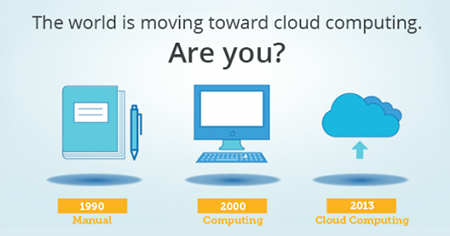
Cloud computing evolution with time from 1990(manual) to 2000(computing) to 2013 (cloud computing)

The provider hosts and maintains the application infrastructure, while authorised users access the payroll system online. The exact hosting model, data location, security controls, support, and availability commitments depend on the vendor and service agreement.

Cloud delivery is now a common deployment model for payroll and HR software. The practical question is not whether payroll can run in the cloud, but whether a platform fits the organisation's payroll processes, compliance needs, integrations, access controls, reporting, support, and budget.

1. Why Is Centralized Payroll Data Useful?

Centralized payroll data can reduce the need to reconcile scattered files and repeated employee updates. The broader employee-lifecycle capabilities available depend on whether the product is payroll-only software or a wider HRMS.

With a cloud payroll software, you can now track and manage all employee lifecycle events such as onboarding, benefits, performance reviews, pay rate changes, leave, certifications, and more, using one centralized source of data. You can also track company assets assigned to employees, from laptops to vehicles, maintain employees' complete work history, and manage all employees' communications from a single centralized location.

A cloud HR and payroll platform can centralize payroll inputs and employee information such as pay changes, leave, attendance, and other approved records. Broader HRMS platforms may also support onboarding, benefits, performance, assets, certifications, and employee communication, depending on the modules enabled.

2. How Can Cloud Payroll Software Support Statutory Compliance in India?

Cloud payroll software can support statutory calculations, updates, records, and reporting for Indian payroll. It should be treated as a compliance-support tool rather than a guarantee of compliance.

Cloud technology offers you nothing short of compliance bliss! The software is updated with the latest compliance changes on the back end, automatically getting reflected on the front end. Be 100% statutory compliant with cloud payroll software and put your TDS, Form 16, PF, PT, and ESI worries to rest for good.

For Indian payroll, relevant obligations can include PF, ESI, Professional Tax, TDS, and Form 16. The employer remains responsible for correct employee data, configuration, review, remittances, filings, and other statutory obligations. Current greytHR payroll software supports functions such as PF calculations and ECR generation, ESI computations, Professional Tax rules, TDS calculations, Form 24Q, and Form 16 generation.

3. How Can Employee Self-Service Reduce Routine Payroll Queries?

Employee self-service can let employees handle routine payroll and HR requests directly, which can reduce the need to contact HR for every payslip, leave, attendance, or tax-information query.

Cloud HR & payroll software offers employee self-service, which empowers staff with 24/7 online access to payslips, benefits, leave requests, real-time attendance data, tax-related information, personal information, and more. This reduces calls and emails to HR staff, and research shows that self-service and mobile access drive employee engagement.

Depending on the platform and permissions, employees can use supported web or mobile access to view payslips, leave and attendance information, tax-related documents, personal information, and configured request workflows. greytHR's Employee Self-Service portal supports payslips, leave and attendance workflows, payroll information, documents, and related employee services.

4. How Does Cloud Payroll Software Connect HR and Payroll Data?

Payroll depends on inputs from areas such as leave, attendance, employee master data, and compensation changes. Integrated systems can reduce duplicate data entry, but the exact integrations, refresh frequency, and workflow depend on the software and configuration.

Rolling out a flawless and timely payroll requires data to flow into the payroll system from multiple other HR systems, such as the leave management system and the attendance management system. The smooth flow of such information can be achieved easily with cloud payroll software, which improves collaboration and facilitates the seamless flow of data through multi-user, web-based access to identical, real-time data across HR systems.

A timely payroll run requires approved data to reach payroll from the relevant HR processes. Where the platform supports integrated leave, attendance, and employee records, teams can reduce manual hand-offs and review the same source data before payroll is finalised.

5. How Can Cloud Payroll Software Simplify Payroll Reporting?

Cloud payroll software can make recurring payroll, statutory, reconciliation, and management reports easier to retrieve and reuse. Reporting depth varies by vendor and plan, so teams should verify both standard and configurable reports before switching.

Cloud HR & payroll software with a core HR software module offers you meaningful reports for effective HR analytics. Other than statutory and labor law reports, you can also access readymade HR MIS reports and even create your own user-defined and ad-hoc reports easily.

A cloud HR and payroll platform may provide statutory reports, payroll MIS, reconciliation reports, and configurable or ad hoc reporting tools. The useful reports are the ones that match the organisation's payroll, finance, audit, and management requirements.

Dashboards and ready-made reports can reduce the need to rebuild the same payroll summaries manually each month. Before selecting software, check whether the system provides the specific reports, filters, exports, and access controls your teams need.

6. Can Employees Access Payroll Information Remotely?

Cloud payroll and HR platforms can provide supported web or mobile access to payroll and HR information outside the office, subject to user permissions, configuration, and the organisation's access policies.

It is easy to see how one might need to view and edit one's leave information, or even apply for leaves, while away from one's office location. Also, one often needs one's payslips and other payroll-related information at banks and other financial institutions. With a cloud HR & payroll software, accessing one's payroll-related information (payslips, tax information, etc.), leave balance, attendance information, and more is possible on the go! Managers can also approve leaves or regularize attendance while on the move.

Employees may need to view payslips, tax information, leave balances, or attendance details while away from the office. Where supported, mobile or web access can allow employees to view this information and submit requests, while managers can approve leave or attendance regularisation according to configured workflows.

7. Can Cloud Payroll Software Reduce IT Infrastructure Requirements?

A SaaS payroll platform can reduce the need to purchase and maintain local payroll servers, but it is not automatically cheaper in every case. Total cost depends on subscription fees, headcount, implementation, integrations, support, migration, and other requirements.

A significant advantage of cloud software is the low investment and high returns it yields. Since there's no physical setup or hardware required, you save a lot on both initial and recurring expenses, including the cost of servers, in-house IT support, etc. Available at highly cost-effective price points, cloud payroll software ensures that even a bootstrapped company can afford one and scale up later without any hassles.

Because the application is vendor-hosted, organisations may avoid some local server, maintenance, upgrade, and infrastructure work. When comparing options, evaluate the full cost of ownership rather than assuming cloud payroll software will always produce a fixed saving or return.

The decision to switch should be based on fit rather than on cloud delivery alone. Compare payroll workflows, Indian statutory requirements, reporting, employee access, integrations, security controls, support, implementation effort, and total cost before choosing a platform.

5 Advantages of Cloud-Based Payroll Software

Cheaper as a subscription, reduces IT related costs

e-payroll software are now offered by service providers as a SaaS (Software as a Service) and comes with monthly/quarterly subscriptions. There is no need to purchase a server(s), which in turn reduces its maintenance, infrastructure, environment, upgrading, security and manpower costs straightaway.

Easy access

e-payroll software can be accessed by authorised personnel from anywhere, from any system and at any time for processing or for any purpose. There is no need to log into one particular system alone.

Timely support / maintenance / automatic updates

System maintenance, upgraded software, new features on application, auto-updates of statutory compliances, latest security firewalls, access or system risk controls as required by auditors are all managed by service providers. This is very helpful as many aspects in payroll such as computations, statutory compliances and reports are common for most organisations. The only thing you will own here is employee data.

Business continuity

Cloud-based payroll software plays a crucial role in supporting business continuity and disaster recovery requirements in case of unforeseen events. These software solutions ensure that both the software itself and the data it manages are securely backed up on multiple servers located at different sites. This proactive measure by service providers helps mitigate the risk of data loss and minimizes downtime, safeguarding the smooth functioning of payroll operations even in challenging circumstances.

Flexibility for multi users

Cloud-based payroll software are flexible for customisation to specific user needs, workflows, reports, MIS, link to different internal systems such as accounting, time & leave management or HR softwares or external systems such as government systems or banking softwares.

8 Definite Benefits Of An Automated Payroll System

7 Ways HRIS Applications Are Beneficial To Your Business

greytHR is a full-suite HRMS platform that supports payroll, employee records, leave, attendance, employee self-service, onboarding, recruitment, and related HR workflows. For a broader overview, see What Is Payroll Software?

About greytHR

greytHR is a full-suite HRMS trusted by 34,000+ businesses and 3.5 million users across 30+ countries. A cloud-based solution with an Arabic mobile app, greytHR enables businesses to manage the complete "hire-to-retire" employee lifecycle in a single, unified system, covering recruitment, onboarding, core HR, leave and attendance, timesheets, payroll and statutory compliance, performance and expense management, and exit. Its AI-powered capabilities bring AI into HRMS workflows, helping modern HR teams automate year-round administrative tasks and free up time for strategic work. greytHR is especially strong in Middle East compliance, with deep WPS, DEWS, and GOSI coverage.

Frequently Asked Questions

What is cloud-based payroll software?

Cloud-based payroll software is payroll software hosted by a service provider and accessed online. It typically reduces dependence on software installed on a specific local machine or server while allowing authorised users to work through supported web or mobile access.

How is cloud payroll software different from desktop payroll software?

Cloud payroll software is generally vendor-hosted and accessed online, while desktop or on-premises payroll software is installed and maintained on local devices or servers. The better option depends on security, integration, access, cost, support, and control requirements.

Can cloud payroll software help with PF, ESI, PT, TDS, and Form 16 in India?

Yes. Payroll software designed for India can support calculations, records, reports, and workflows for PF, ESI, Professional Tax, TDS, Form 16, and other applicable payroll requirements. Employers remain responsible for correct inputs, review, remittances, filings, and compliance.

Is cloud payroll software secure?

Security depends on the vendor's controls and the customer's configuration. Evaluate role-based access, encryption, authentication, backups, disaster recovery, audit controls, data-handling practices, and contractual commitments instead of assuming that every cloud payroll platform provides the same level of security.

What should a business check before switching to cloud payroll software?

Check payroll fit, Indian statutory capabilities, integrations, employee self-service, reporting, access controls, security, migration requirements, implementation support, service commitments, and total cost. A successful switch depends on how well the platform matches the organisation's real payroll processes.

Author(s)

Vinod Gulvady

Vinod Gulvady, the author of greytHR, prioritizes work and likes to plan and organize it accordingly.

Share this

facebooktwitterlinked inwhataspp
link

Related Posts

Info Tile Image
29/06/2026 | greytHR

Bahrain's Enhanced WPS Is Live. Here’s What Private Sector Employers Need to Do Differently

Master Bahrain's Enhanced WPS rules for 2026. This comprehensive guide covers pre-payment LMRA validation, mandatory WRP appointments, and payroll workflows.
Statutory Compliances

Subscribe to our newsletter

  • Product
  • HR Software
  • Payroll Software
  • Leave Management
  • Attendance Management
  • Employee Self Service
  • Employee Engagement
  • Performance Management
  • Recruitment Software
  • Expense Management
  • greytHR Service Status
  • greytHR Customers
  • greytHR Help
  • Login
  • Videos
  • PlayStoreAppStore
greytHR-logo
GDPR Compliant certification badgeSoc2 certification badgeISO Certification Badge
© 2026 Greytip Software Pvt. Ltd.
Privacy PolicyTerms of Use