


The Wage Protection System (WPS) in the UAE is a government-mandated electronic system that facilitates timely and proper payment of wages to private sector workers. The WPS covers a broad spectrum of sectors, such as manufacturing, construction, property, retail, hospitality, health services, education, transport and logistics, financial services, and IT, to mention but a few.
An initiative by the Ministry of Human Resources Emiratization (MoHRE) in collaboration with the Central Bank of UAE, the WPS protects the rights of employees and is a key component of the UAE Labor Law. The system helps curb any illegal activities by employers, such as inappropriate salaries, delaying payment cycles, or drawing from illegal sources of funds to pay salaries.
WPS compliance in the UAE requires employers to pay eligible workers through approved channels, submit accurate Salary Information Files (SIFs), and meet the salary-payment rules effective in 2026. This guide covers WPS registration, benefits, SIF creation, compliance requirements, penalties, and the role of payroll software in reducing errors.
Quick Summary
- The UAE Wage Protection System enables MoHRE and the Central Bank of the UAE to monitor salary payments made through approved banks, financial institutions, and exchange houses.
- From 1 June 2026, wages for the preceding month are due on the 1st, the WPS compliance threshold is 85%, and new employees fall within WPS scope from their first day.
- Employers must register through MoHRE and work with a WPS-approved bank, exchange house, or financial institution to process salary transfers.
- A Salary Information File (SIF) is the standard payroll file used to submit employee and salary data through the UAE WPS.
- Non-compliance can trigger escalating MoHRE action including warnings, work permit restrictions, fines, and administrative closure.
- Accurate employee data, correct SIF formatting, timely funding, and complete payroll records are central to WPS compliance.
- WPS-compatible payroll software can automate SIF generation, reduce rejection risks, and maintain an auditable salary-payment record.
How to register for WPS in UAE?
Employers register through MoHRE and work with a WPS-approved bank, exchange house, or financial institution to process salary transfers. Registration requires valid company documents, employee salary details, and the service documents requested by the selected WPS agent.
Employers must follow the guidelines given below to enroll for WPS:
- Visit the MoHRE online portal to register.
- Select the right WPS-approved agent to manage salary transfers. Employers must have a corporate account with the same agent.
- Submit the necessary documents. While the documents that need to be submitted may vary depending upon the nature of the business and industry, the standard documents required are:
- A valid trade license.
- All documents related to company registration.
- List of employees with their bank account details.
- Documents of authorized signatory.
- Duly filled WPS registration form provided by the chosen agent.
- Signed WPS service agreement with the agent.
What are the benefits of WPS in the UAE?
WPS protects employees by creating a transparent record of salary payments and helps employers demonstrate compliance with UAE wage-payment requirements. It also supports dispute resolution, payroll oversight, and timely salary processing.
The WPS has multiple benefits for employers as well as employees. Some of the key benefits of WPS are as follows:
For employers:
- Enhanced credibility and trust: A WPS-compliant company indicates that it is dedicated to ethical labor practices, reinforcing its statute as a trustworthy entity among employees, customers, and the wider business world. This leads to improved employee satisfaction and loyalty and boosts employee retention.
- Legal compliance: The system helps companies to avoid compliance issues with UAE labor laws. In addition, it helps to identify mistakes and allows sufficient time to rectify and avoid penalties or work permit restrictions, which can disrupt business operations.
For employees:
- Tracking salary disbursements: WPS is designed to track all salary transfers and enforces strict deadlines for salary processing to ensure that workers are paid on time and in full. To ensure that the payroll processing is valid and accurate, the WPS system checks the accuracy of payments against the submitted Salary Information File (SIF).
- Safeguarding employee rights: The WPS provides a legal framework that protects employees from exploitation and underpayment. It provides a transparent record of payments that is crucial for dispute resolution.
- Comprehensive database: The system has an all-encompassing database that is a credible point of reference in case of wage-related conflict.
What is SIF?
A Salary Information File (SIF) is the standard payroll file used to submit employee and salary data through the UAE WPS. It allows the payment agent and regulators to verify that wages match the employer's payroll instructions and employment records.
SIF or Salary Information File is the instrument through which payment processing and transfers are carried out in WPS. SIF consists of employee salary details that must be submitted in a specific format. SIF includes information as given below:
Company details:
- Company name and ID.
- Payroll period (month and year).
- Total number of employees.
- Total salary amount.
Employee details:
- Employee name and labor card number.
- Bank account or wage card number.
- Salary amount.
- Number of days worked.
- Overtime hours and the amount.
- Allowances and deductions.
How to create a SIF?
To create a SIF, employers must compile accurate company, employee, and payroll information in the prescribed WPS format, validate the file, and submit it through their approved WPS agent. Incorrect fields or formatting can lead to rejection and delayed salary payment.
One of the biggest challenges of creating a SIF is maintaining accuracy so that it is not rejected by the WPS agent. Employers must adhere to the guidelines given below to avoid rejection of SIF:
- Collect accurate employee payroll data.
- Use payroll software to avoid human errors.
- Ensure the data is formatted according to WPS requirements.
- Create templates and direct the payroll team to follow these templates.
- It is advisable to utilize WPS-compatible payroll software to automatically prepare the SIF.
- Check the SIF carefully before submitting.
- Submit the SIF to your WPS agent within the required timeframe.
What Changed in the UAE Wage Protection System in 2026?
From 1 June 2026, MoHRE-licensed private-sector employers must align payroll with a single monthly salary deadline and tighter WPS monitoring. The changes affect salary timing, compliance measurement, new joiners, and the treatment of certain employee categories.
Salary Deadline
Wages for the preceding Gregorian month are due on the 1st of each month. Payment after the 1st is treated as delayed for WPS purposes.
85% Compliance Threshold
An establishment must transfer at least 85% of total wages due, and an employee is treated as paid when at least 85% of the entitled wage is transferred, subject to lawful deductions.
New Employees
The earlier 30-day exemption is removed. New joiners fall within WPS scope from their first day of employment.
Recognized Exclusions
Active wage disputes, formally reported absconding cases, judicial or administrative restrictions, and unpaid leave are among the situations that may be excluded from violation calculations when properly recorded.
Employer Accountability
Employers remain responsible for accurate and timely payment even when payroll processing is delegated to a third-party provider.
What Happens if an Employer Does Not Comply?
WPS non-compliance can trigger escalating MoHRE action based on the delay, number of affected employees, and the employer's compliance history. Measures can include warnings, suspension of new work permits, fines, labour-dispute action, and further legal or administrative measures. Employers should treat any salary payment after the 1st as a compliance exception requiring immediate review and correction. Repeated or prolonged non-payment may lead to stronger restrictions and enforcement than an isolated processing error. Accurate SIFs, proof of payment, exemption records, and payroll audit trails should be retained for MoHRE review.
How can greytHR help businesses manage WPS compliance?
greytHR supports UAE payroll teams by automating payroll calculations, generating WPS-compliant SIFs, maintaining salary records, and reducing the manual errors that can delay or invalidate submissions.
Businesses in the UAE often find it challenging to ensure compliance with WPS due to recurrent regulatory amendments and the chances of manual errors in Salary Information Files (SIFs).
| WPS Compliance Challenge | greytHR’s Automated WPS Compliance Solution |
|---|---|
| Manual SIF creation: Manually creating SIFs is tedious, time-consuming, and prone to errors, resulting in payment delays and rejections. | Generates WPS-compliance files, reducing errors and rejections. |
| Regulatory updates: Keeping pace with evolving WPS regulations can be difficult and requires continuous monitoring to avoid compliance failures. | Enables companies to stay updated and compliant with the latest UAE labor law and policies without manual tracking. |
| Payroll delays: Miscalculations, incorrect formats, or missed deadlines can lead to penalties and delayed salary disbursements. | Eliminates miscalculations and reduces payment delays by ensuring accurate wage disbursement. |
| Approval process: WPS files must adhere to a specific format defined by banks and the Ministry of Labor. | Integrates with approved banking formats and labor authority requirements, simplifying approvals. |
| Administrative burden: Manual compliance processes can cause HR teams to spend a lot of time on compliance tasks, taking time away from other strategic HR work. | Reduces compliance burden on HR teams and allows them to drive strategic and employee engagement initiatives. |
How does greytHR simplify SIF creation?
greytHR generates SIFs from verified payroll data in the required format, helping HR teams reduce manual preparation, formatting errors, and rejected salary files.
To know more about greytHR’s HRMS and how it can help businesses in the UAE and the Middle East, click here: greytHR | Full Suite HRMS for MEA Businesses.
About greytHR
greytHR is a full-suite HRMS trusted by 34,000+ businesses and 3.5 million users across 30+ countries. A cloud-based solution with an Arabic mobile app, greytHR enables businesses to manage the complete "hire-to-retire" employee lifecycle in a single, unified system, covering recruitment, onboarding, core HR, leave and attendance, timesheets, payroll and statutory compliance, performance and expense management, and exit. Its AI-powered capabilities bring AI into HRMS workflows, helping modern HR teams automate year-round administrative tasks and free up time for strategic work. greytHR is especially strong in Middle East compliance, with deep WPS, DEWS, and GOSI coverage.
FAQs
What is the Wage Protection System (WPS) in the UAE?
The Wage Protection System or WPS is an electronic salary transfer system mandated by the UAE government that enables employers to transfer employee salaries through approved authorities like banks, financial institutions, and exchange houses. The system was initiated in 2009 and ensures that salaries are processed according to employment contracts and labor laws in the UAE, reducing wage-related disputes and fostering financial security for workers.
What are the key features of WPS?
The key features of WPS are as follows:
- It ensures timely and proper payment of salaries to employees.
- It regulates employer-employee salary transactions.
- The system is monitored by the Central Bank of UAE and MoHRE (Ministry of Human Resources and Emiratization).
- The system applies to all companies registered with MoHRE.
- It supports multi-currency salary payments.
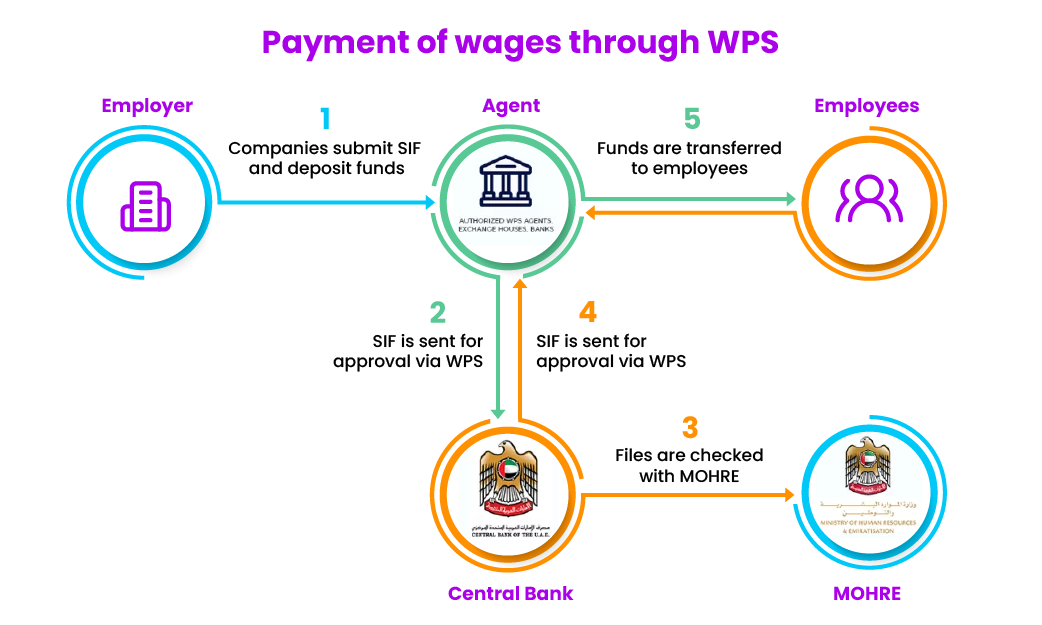
How does WPS work?
The WPS process involves the following steps:
- Employer registration: Companies must first register with MoHRE and a WPS-approved agent (bank or exchange house). Depending on the structure, type, size, and location, companies must submit the necessary documentation and agree to the terms of the WPS.
- Prepare and submit Salary Information File (SIF): Employers must create detailed SIFs that include employee information and salary details for each employee and submit them to the WPS-approved agent in a specific format through the bank’s or agent’s website.
- Salary verification: The MoHRE and Central Bank check the submitted SIF of the employer and cross-check the same with the salary information of the employees in order to determine compliance with the labor laws as well as accuracy of data.
- Issuing payment order: Once the information is verified, the employer issues a payment order to their WPS agent for the total salary amount.
- Salary transfer instruction: The WPS agent processes the payment order and prepares individual salary transfers per the SIF.
- Salary disbursement: Upon approval, salaries are transferred to employee accounts through the designated financial institution.
How to choose a WPS agent?
Selecting the correct agent ensures that employers need not stress about
timely payment of salaries. The guidelines given below will help to make the
right choice:
- Reputation and credibility of the bank or financial institution.
- Other employers’ experience with the WPS agent.
- WPS service fees (agents determine it, so always opt for better alternatives).
- Technological platform and simplicity.
- Customer support and responsiveness.
- Other services provided (e.g., wage cards, mobile banking).
- Integration capabilities with current payroll systems.
How to check the WPS status of a company?
Once a company is successfully registered, they can verify its status in the following way:
- Visit the official MoHRE website: https://www.mohre.gov.ae/en/home.aspx
- Click on the "Services" tab and select "New Enquiry Services” from the drop-down.
- On the new page, select the service as required.
- Choose "Company information" from the drop-down.
- Enter the company number. The result will show company information including its WPS status.
Is WPS mandatory for all companies in the UAE?
WPS is mandatory for private-sector establishments and workers covered by MoHRE requirements. Some employee categories and establishments may be excluded or governed by separate rules. Free-zone employers should follow the requirements of their respective authority where a separate WPS framework applies.
When must salaries be paid through WPS in 2026?
From 1 June 2026, wages for the preceding Gregorian month are due on the 1st of each month for employers covered by the updated MoHRE framework.
What is the 85% WPS compliance threshold?
An establishment is treated as compliant when it transfers at least 85% of total wages due. At employee level, at least 85% of the entitled wage must be transferred, with any shortfall arising only from lawful and properly documented deductions.
Are new employees covered by WPS from their first day?
Yes. Under the 2026 framework, the previous 30-day exemption for new employees is removed. Employers must include a new joiner's applicable salary in the payroll cycle from the employee's first day of employment.
What happens if a Salary Information File is rejected?
A rejected SIF can delay salary transfer and create a WPS compliance risk. Employers should correct the data or formatting issue immediately, resubmit the file through the approved agent, and retain records of the correction and final payment.
Does WPS apply to UAE free-zone companies?
The updated MoHRE framework directly covers MoHRE-licensed private-sector employers. Free zones may operate their own wage-protection requirements or adopt separate implementation timelines, so employers should check the rules issued by their licensing authority.
Can payroll software automate UAE WPS compliance?
Yes. WPS-compatible payroll software can calculate payroll, generate the SIF in the required format, apply configured deductions, preserve payment records, and support audit-ready reporting. Employers remain responsible for reviewing data and completing the transfer on time.
Author(s)
greytHR
greytHR is a full-suite HRMS platform that automates HR processes and empowers employee self-service. It ensures all-around productivity and engaged employees — the crucial ingredients for growth.Share this


