


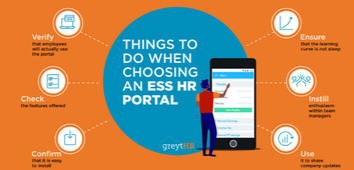
An employee self service portal should be easy for employees and managers to use, support the HR tasks they perform most often, integrate with relevant HR systems, work well on mobile devices, protect employee data, and provide suitable workflows and communication tools. The right ESS portal should match how your workforce actually uses HR services.
Quick Summary
- Employee adoption: Understand which self-service tasks employees actually need and are likely to use.
- Core features: Prioritize payslips, leave, attendance, employee information, documents, requests, and relevant approvals.
- Integration: Check how the ESS portal connects with payroll, attendance, leave, and other HR workflows.
- Usability and mobile access: Make sure employees can complete common tasks without extensive training.
- Manager self-service: Ensure managers can review and act on relevant employee requests efficiently.
- Security: Review authentication, access controls, permissions, auditability, and employee-data protection.
- Communication: Check whether policies, announcements, notifications, and employee queries can be managed appropriately.
Self-service is the order of the day. Employees expect to be in charge of their own attendance management, document updating, and payroll monitoring, and ESS (employee self-service) portals can allow them to do just that through a user-friendly interface. There are several ESS HR portal solutions to choose from, catering to different industries and company types.
Employee self-service (ESS) portals give employees direct access to routine HR information and transactions such as payslips, leave, attendance, documents, and approved profile updates. With multiple employee self-service software options available, HR teams should evaluate adoption, features, integration, usability, manager workflows, security, and communication before choosing a portal.
What Should You Look for When Choosing an ESS Portal?
The right ESS portal should make common HR transactions easier for employees and managers while fitting the organisation's existing HR processes. Evaluate the portal on adoption, core features, integration, usability, manager workflows, security, and communication rather than choosing on feature count alone.
1. Will Employees Actually Use the ESS Portal?
While self-service may sound attractive, many employees may resist introducing a new tool as an extra inconvenience. Conduct an internal survey to understand what your employees hope to get out of the ESS HR portal and how much time they are willing to spend on it.
While self-service may sound attractive, employees may resist a new tool if it adds steps rather than removing them. Ask employees which HR tasks they most often need help with, such as accessing payslips, checking leave or attendance, or updating personal information, and evaluate whether the portal makes those tasks quicker and easier.
2. What Features Should an Employee Self-Service Portal Have?
In order to maximize the benefits of employee self-service, it is important to make sure that the portal combines as many useful features as possible. Some of the features common to most top-notch portals include leave requests, payroll history, information change requests, a knowledge library, training modules, and peer-to-peer messaging. Uploading details about new jobs or training certificates could also encourage employees to seek out those opportunities for growth on their own initiative.
To maximize the benefits of employee self-service, prioritize the features employees and managers use most often. Common capabilities include leave requests and balances, attendance information and regularisation, payslips and payroll information, personal-information change requests, documents, policies, and relevant approvals. Additional capabilities vary by platform, so evaluate them against actual workforce needs.
3. How Well Does the ESS Portal Integrate With Your HR Systems?
An ESS HR portal should be compatible with your existing office hardware and systems. The less you need to spend on setup costs, the more open the IT team will be to work with it. Do your research on the portals available out there and choose the most cost-effective option for your company.
An ESS portal should work with the HR systems and processes your organisation already uses. Check how it connects with payroll, leave, attendance, employee records, and other relevant workflows, and what implementation, configuration, migration, browser, or mobile requirements are involved. Compare the overall implementation fit and cost rather than setup price alone.
.png)
4. Is the ESS Portal Easy for Employees to Use?
The benefits of ESS get outweighed if the portal itself is difficult to navigate. Ensure that it has a simple interface with clearly labelled features and that it loads equally well across different browsers and internet speeds. Ideally, the portal should also have a mobile app version so that employees can access it on the go.
The benefits of ESS are reduced if the portal itself is difficult to navigate. Look for a simple interface, clearly labelled functions, mobile access, and a reliable experience on the browsers and devices your workforce uses. Test common employee tasks on the actual devices and connections employees are likely to use.
5. Does It Support Manager Self-Service and Approvals?
An ESS HR portal can potentially be used to learn more about employee sentiment concerning issues like turnover, compensation, and work culture. To make the most of this, HR should focus separately on educating managers about the tool and on promoting manager self-service options.
Employee self-service works best when managers can complete their side of the workflow in the same system. Check whether managers can review leave requests, attendance regularisation, and other relevant employee requests, view appropriate team information, and receive workflow notifications without relying on HR to relay every transaction.
6. How Does the ESS Portal Protect Employee Data?
An ESS portal can expose or process sensitive employee information, including payroll, attendance, leave, personal details, and documents. Evaluate authentication, role-based permissions, access controls, audit history, and how access is updated when employees join, change roles, or leave. Security controls should match the sensitivity of the information available through the portal.
7. Can the ESS Portal Support Employee Communication?
Apart from giving employees control over day-to-day functions, the other significant benefit of an ESS HR portal is the ability to share company news and updates instantly. Policy changes can be uploaded on the portal for employees to peruse at their leisure, and the direct messaging feature can be used to share queries and complaints. Company schedules of holidays, events, and other important dates can be updated publicly so that employees can confirm their presence through their login IDs.
Beyond day-to-day HR transactions, some ESS portals can also support employee communication. Depending on the platform, HR may be able to publish policies and company updates, send reminders, provide employee-directory access, or route employee queries through a helpdesk. Treat these as additional capabilities and verify which communication features are included in the product you are evaluating.
As automation becomes the norm across industries, a self-service portal is a natural choice to improve HR efficiency. With multiple options available, a company of any size can find the right ESS HR portal for itself and start reaping the benefits of employee self-service today.
The right employee self-service portal is not necessarily the one with the longest feature list. It should make common HR transactions easier for employees and managers, integrate with the HR processes your organisation uses, protect employee information, and be simple enough for people to adopt consistently.
About greytHR
greytHR is a full-suite HRMS trusted by 34,000+ businesses and 3.5 million users across 30+ countries. A cloud-based solution with an Arabic mobile app, greytHR enables businesses to manage the complete "hire-to-retire" employee lifecycle in a single, unified system, covering recruitment, onboarding, core HR, leave and attendance, timesheets, payroll and statutory compliance, performance and expense management, and exit. Its AI-powered capabilities bring AI into HRMS workflows, helping modern HR teams automate year-round administrative tasks and free up time for strategic work. greytHR is especially strong in Middle East compliance, with deep WPS, DEWS, and GOSI coverage.
Frequently Asked Questions
What should you look for in an employee self-service portal?
Look for an ESS portal that employees and managers can use easily for recurring HR tasks. Evaluate the features your workforce actually needs, integration with payroll, leave and attendance, mobile access, manager approvals, security controls, communication options, implementation requirements, and the level of support available from the vendor.
What features should an ESS portal include?
Useful ESS features commonly include access to payslips and payroll information, leave applications and balances, attendance information and regularisation, employee-data change requests, documents and policies, manager approvals, notifications, and mobile access. Additional capabilities vary by platform, so feature selection should reflect your organisation's actual workflows.
Should an ESS portal integrate with payroll, leave, and attendance?
Yes, integration with relevant HR processes can reduce duplicate data entry and make employee and manager workflows more consistent. Buyers should check how the ESS portal connects with payroll, leave, attendance, and employee records, which data moves between systems, and what approvals or validation steps remain part of each workflow.
Why is mobile access important in employee self-service software?
Mobile access lets employees and managers complete routine HR tasks without relying on a desktop, which can be useful for distributed, frontline, field, and hybrid workforces. When evaluating mobile access, test the tasks employees use most often and confirm which features are available on supported mobile devices.
What security features should you check in an ESS portal?
Check how the portal authenticates users, controls access by role, records important changes, protects sensitive employee information, and updates permissions when employees join, move roles, or leave. Also review the vendor's security practices, backup and recovery arrangements, and any relevant security certifications or independent assurance reports.
Author(s)
Vijay Balakrishnan
Vijay Balakrishnan is the Chief Marketing Officer at Greytip, leading the Marketing function. As a results-driven marketer, he has held Marketing Leadership & CXO positions at some of India’s largest and finest corporations.Share this