


Payroll management for construction companies in the UAE is not easy. The challenges lie in simplifying finances for compliance and reducing the overwhelming complexity of fluctuating work hours, diverse worker classifications, and overtime calculations. The policies change regularly and, if left unattended, can cost hefty penalties.
So, how do companies meet such complex requirements? Companies can use payroll management software to automate salary calculations, applicable pension or social security contributions, end-of-service gratuity, employee benefits, and compliance processes such as WPS and Emiratisation.
This article focuses on the key aspects that every construction company in the UAE needs to understand as they streamline their payroll processes efficiently and compliantly.
Quick Summary
- Construction payroll in the UAE is shaped by irregular work hours, overtime, workforce diversity, multiple job sites, seasonal hiring, and frequent employee movement.
- Practical ways to improve payroll management include digital attendance, automated payroll software, regular audits, and cloud payroll software.
- WPS compliance, UAE labour requirements, end-of-service gratuity, and applicable pension or social security obligations all need to be reflected accurately in payroll processes.
- Payroll software can connect attendance, employee self-service, compliance, reporting, and final settlements for distributed construction teams.
What Factors Affect Payroll Management in Construction Companies in the UAE?
Construction payroll is affected by irregular schedules, overtime, varied worker categories, multiple sites, seasonal hiring, high turnover, and statutory requirements. Together, these factors make accurate attendance capture, wage calculation, compliance, and final settlements more difficult than in a fixed-location workforce.
Factors Affecting Payroll Management in the Construction Industry
Construction projects have irregular schedules with rotational shifts, overtime, and an evolving scope of work. Such unpredictability makes tracking attendance and calculating wages a constant struggle. The challenges multiply as more people join a project at varying capacities. With every hire, the employer must train and certify the employees so that they can join the workforce. Managing payroll adjustments for trainees, allowances, and certifications adds another layer of complexity.
Other notable challenges include:
- Workforce Diversity: Construction sites employ a mix of skilled and unskilled labor from different nationalities with varying contract structures. Without an reliable payroll management system, ensuring equitable payroll policies that comply with varying regulations emerges as a major challenge.
- Safety Compliance Costs: Workers in high-risk roles must be compensated appropriately with hazard pay, insurance, and medical coverage. Failure to integrate these factors into payroll can result in disputes and major compliance issues.
- WPS and Labor Law Compliance: Non-compliance with WPS, such as late payments, incorrect overtime calculations, or mismanaged leave policies, can lead to fines, work permit restrictions and other enforcement action.
- High Employee Turnover and Visa Processing: The construction industry faces a challenge of a high turnover rate. Frequent hiring/employee exits involve visa processing and compliance, payroll adjustments, and final settlements, contributing to the administrative load.
- End-of-Service Benefits (gratuity) Mismanagement: Calculation and payment of gratuity to expatriates on a timely basis can be complex when employees are frequently changing jobs and contracts have different terms.
- Processing Overtime and Shift Payments: Large construction projects frequently involve prolonged working hours, night shifts, or working on weekends. Precise documentation of overtime work, its repayment, and adherence to UAE labor regulations remain recurring challenges for HR teams.
- Multi-Currency Payroll Issues: Construction firms tend to have employees from various countries who want to receive their pay in their native currency. Multi-currency payroll, exchange rate volatility, and cross-border payments can make payroll management difficult.
- Seasonal Employment: Labor demand fluctuates based on project timelines, leading to an influx of temporary workers. Managing payroll for short-term contracts while ensuring accurate record-keeping and compliance remains challenging.
- Multiple Locations: Usually, construction companies have projects spread across different locations within a city, region or country. These projects have a mix of permanent and contractual labor, adding complexity.
How Can Construction Companies in the UAE Streamline Payroll Management?
Construction companies can simplify payroll by digitising attendance and leave, using automated payroll software, running regular payroll audits, and choosing cloud payroll software that can support multiple sites, complex pay inputs, WPS processes, and employee self-service.
Considering the factors influencing payroll management, a simplified payroll solution is necessary. Here are a few ways to simplify payroll processes.
Go Digital
Companies must aim to transition from manual leave and attendance monitoring to online management systems. Online leave and attendance management systems can automatically sync attendance and leave data for an employee, such as total work hours, number of leaves, and overtime in a month, with payroll. This eliminates manual data entry, accelerates payroll processing, enhances accuracy, and ensures WPS and labor law compliance. Integrating a digital employee self service portal (ESS) enables workers to check real-time leave and attendance data through mobile phones and perform basic HR tasks like applying for leaves or downloading payslips from anywhere, anytime, without having to route their queries through HR teams.
Automate Payroll Systems
Switch to automated payroll software that can handle complex payroll structures, including statutory deductions, overtime, allowances, and payroll adjustments. To support compliance with UAE labor laws and WPS, construction companies should opt for software that can manage multiple scenarios and simplify the entire process, including inputs, payouts, claims, compliance, and self-service settlements. AI in payroll can add another layer of support by helping teams surface unusual inputs, recurring exceptions, and payroll patterns that need review before processing, particularly across large and variable workforces.
Ensure Regular Payroll Audit
Perform periodic payroll audits by verifying wage calculations, overtime payments, and deductions to check consistency with UAE labor regulations and avoid errors. This ensures errors are traced, penalties are averted, and financial records are accurate.
Choose Cloud-Based Payroll Software
Cloud payroll software can provide crucial benefits for construction companies that are composed of architects, site managers, and workers distributed across different sites and locations.
- Enables HR staff and employees to view payroll information from anywhere – on-site, in the office, or remotely. On-premise software limits access to office-based systems.
- Cloud payroll solutions are easier to update as labour laws, statutory requirements, and software capabilities change. With on-premise software, organizations must manually upgrade their system, which can lead to compliance errors.
- On-premise payroll is dependent on hardware, servers, and IT teams. Cloud-based payroll eliminates these expenses, providing a cost-saving and scalable solution with pay-as-you-go pricing structures.
- Cloud payroll is ready to use and scales easily as a company grows, adding new employees or job sites without infrastructure changes.
- Cloud payroll provides self-service portals, enabling employees to view salary details from any device. On-prem installations are generally inaccessible from mobiles, contributing to additional HR questions.
Choose the Right Payroll Software Provider
The right payroll software provider should align with the requirements mentioned above and ensure comprehensive support before, during, and after the payroll software is integrated. greytHR provides cloud-based HR and payroll management software that automates the full payroll cycle, supports WPS and labour-law compliance in the Middle East, and provides dedicated support at every step.
What Makes greytHR the Right Payroll Option?
greytHR brings payroll, attendance inputs, statutory compliance, employee self service, and reporting into one system. For construction companies managing distributed teams and variable payroll inputs, this can reduce manual work and make payroll processing easier to manage across sites.
greytHR’s payroll software simplifies, automates, and streamlines the payroll process end-to-end. From accurate calculations of salaries to automated tax compliance, it significantly reduces manual calculation errors and payroll inaccuracies. With greytHR, organizations can focus on strategic initiatives rather than routine payroll activities.
Key Features
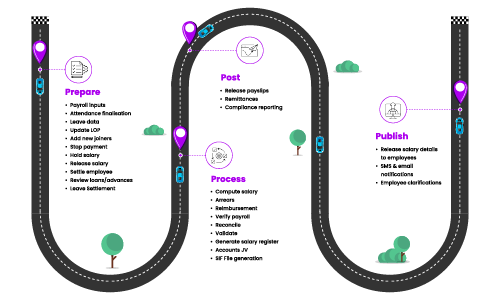
- Payroll Processing: Fast, accurate payroll management with highly customizable salary structures, unlimited salary components, SIF file generation, leave and arrears settlements, loans, and reimbursements.
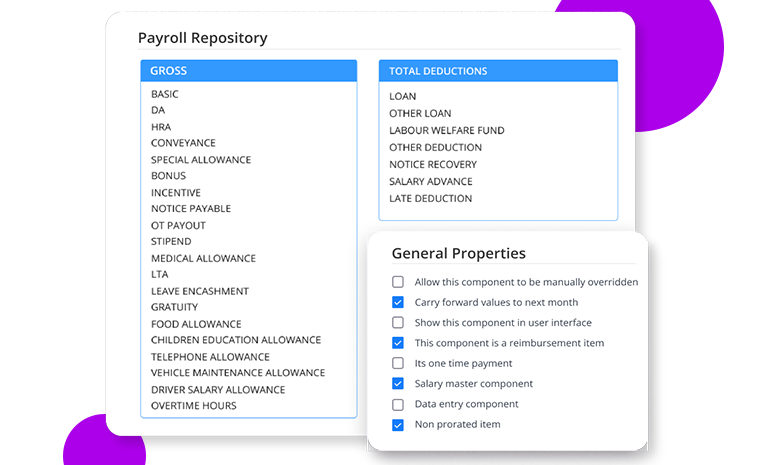
Statutory Compliance: Automated compliance management, including gratuity and timely disbursement of salaries.
Employee Self-Service (ESS) Portal: Reduces administrative work by 80%, providing employees with easy access to payroll data, reimbursement claims, and online submissions via a mobile app or web portal.
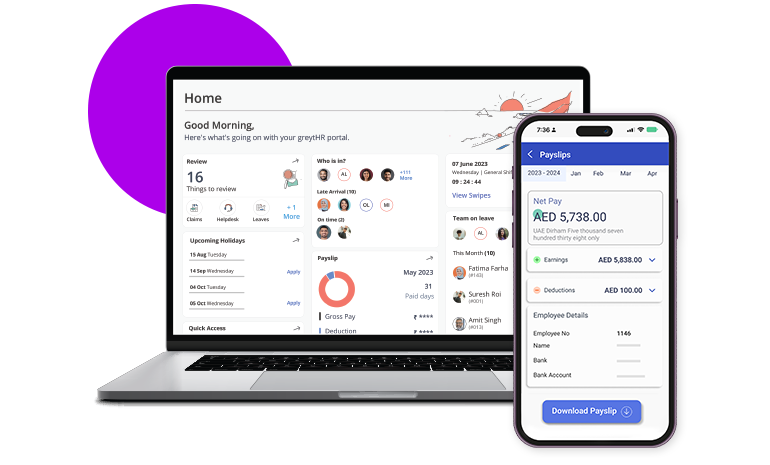
- Reports & Analytics: Hundreds of pre-built reports for MIS, statutory compliance, payroll statements, and ad-hoc queries. Customization options for specific reporting needs and payroll analytics for better decision-making.
Benefits
- Speed: Payroll processing is completed in minutes.
- Accuracy: Ensures error-free, compliant payroll calculations.
- Trust: A transparent self-help portal builds employee trust.
- Reliability: 99.5% uptime and hassle-free month-end processes.
Certifications
greytHR is GDPR-ready and also complies with SOC2, and ISO standards, ensuring data security and reliability.
The Bottom Line
For construction companies in the UAE, the strongest payroll setup is one that connects workforce data with accurate salary processing, WPS compliance, reporting, and employee access. As projects and headcount scale, cloud payroll software can reduce the administrative effort needed to keep these processes consistent.
The construction industry in the UAE is on a growth trajectory, set to reach USD 52.66 billion by 2030, driven by proactive government policies, PPP initiatives, and investor-friendly regulations. But with growth comes the challenge of managing large, distributed workforces, project-based payroll, and strict compliance requirements.
If your construction business is looking to cut costs, stay compliant, and scale effortlessly, greytHR can help. See how it works:[Schedule a Demo Today] | Learn More
About greytHR
greytHR is a full-suite HRMS trusted by 34,000+ businesses and 3.5 million users across 30+ countries. A cloud-based solution with an Arabic mobile app, greytHR enables businesses to manage the complete "hire-to-retire" employee lifecycle in a single, unified system, covering recruitment, onboarding, core HR, leave and attendance, timesheets, payroll and statutory compliance, performance and expense management, and exit. Its AI-powered capabilities bring AI into HRMS workflows, helping modern HR teams automate year-round administrative tasks and free up time for strategic work. greytHR is especially strong in Middle East compliance, with deep WPS, DEWS, and GOSI coverage.
FAQs
These FAQs cover common questions about payroll compliance, WPS, salary calculation, cloud payroll software, and payroll operations for construction companies in the UAE.
What is the payroll process in the United Arab Emirates?
The payroll process in the UAE involves creating a payroll system that follows legal standards, calculating employees’ wages and benefits correctly, processing payroll on time, maintaining sufficient records of United Arab Emirates payroll amounts, and submitting WPS reports monthly.
Is there a tax on payroll in the UAE?
There is no payroll tax in the UAE. However, the citizens must contribute to schemes like the General Pension and Social Security Authority (GPSSA) and the Abu Dhabi Pension Fund (ADPF).
Is the salary calculated for 30 days in the UAE?
In the UAE, the remuneration paid for a month can be either based on thirty days or the actual number of days based on the company’s agreed payroll policy and the individual contract between the employee and the employer.
Why is cloud payroll software useful for construction companies?
Cloud payroll software gives HR and payroll teams access to payroll information across sites without depending on office-based systems. It can also make it easier to scale for new projects, employees, and locations while keeping payroll data, reports, and employee access in one system.
How can payroll software manage overtime and multiple construction sites?
Payroll software can connect attendance and shift data from different sites with payroll rules for overtime, allowances, leave, and settlements. This reduces repeated data entry and gives payroll teams a more consistent process for workers whose hours, locations, or project assignments change during the month.
Author(s)
greytHR
greytHR is a full-suite HRMS platform that automates HR processes and empowers employee self-service. It ensures all-around productivity and engaged employees — the crucial ingredients for growth.Share this


